
"Radici": Spoleto returns to the center of the world
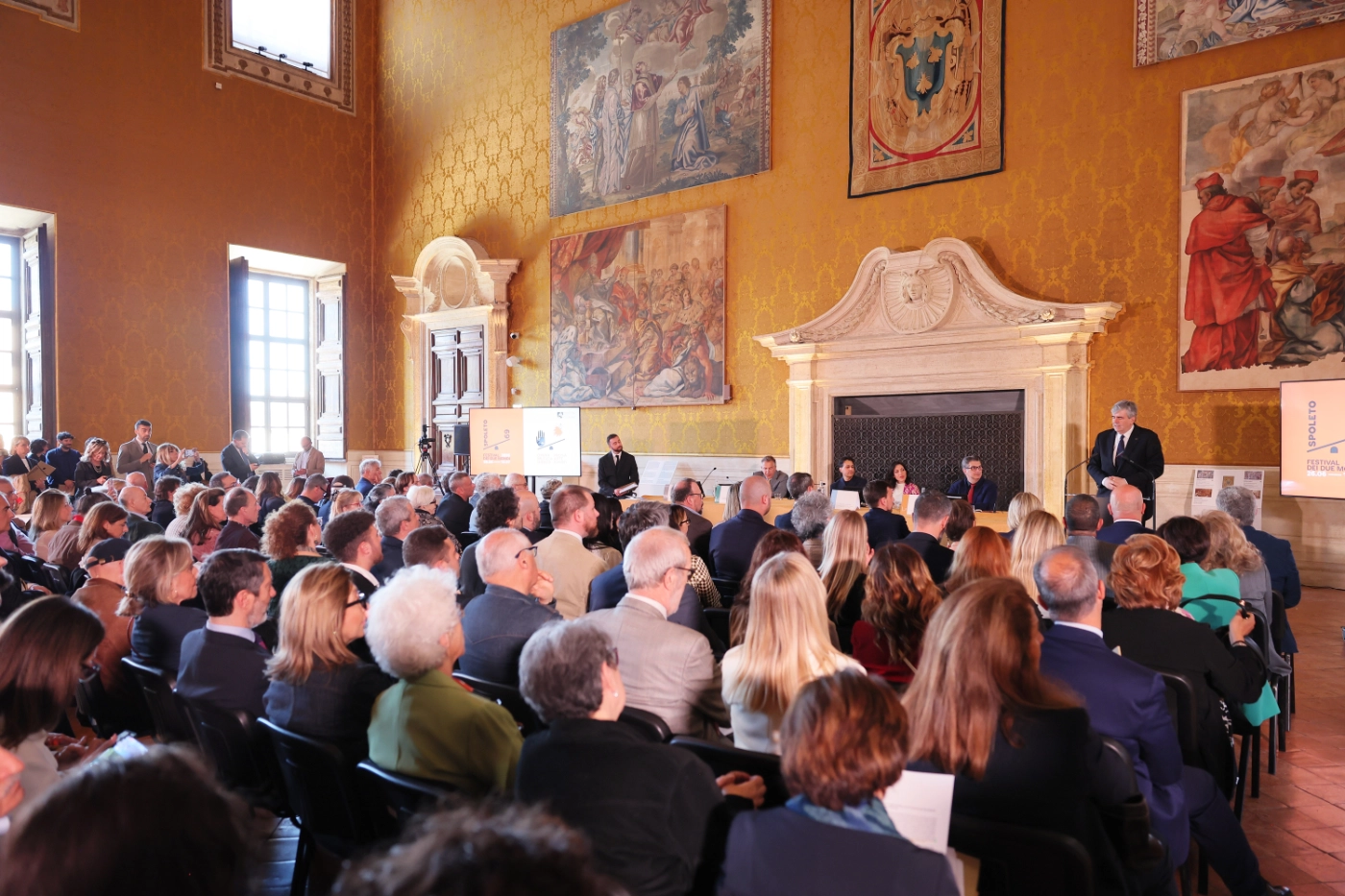
In the Salone Pietro da Cortona of Palazzo Barberini, the press conference for the 69th edition of the Festival dei Due Mondi di Spoleto was held, attended by the Minister of Culture Alessandro Giuli, the President of the Fondazione Festival dei Due Mondi and Mayor of Spoleto Andrea Sisti, Artistic Director Daniele Cipriani, classical music consultant Beatrice Rana, opera and theatre consultant Leo Muscato, and moderated by journalist and presenter Marco Carrara.
The festival, scheduled from June 26 to July 12, 2026, is set to enliven one of the longest-running international stages of art and culture with a program rich in world premieres, global excellence, and emerging talents. Expanding the multidisciplinary mission and global vocation the Festival has always championed, this year opera, music, dance, theatre, and art will engage in dialogue across cultures and contemporary languages in a new shared dimension, where the theme of “Radici” embodies both the value of the past and the force of change. Seventeen days of programming, 100 performances—including 7 world premieres and 9 original Festival productions—with over 1,000 artists from 27 countries, for a total of 16,508 minutes of programming, equal to 275 hours, or roughly eleven and a half days of uninterrupted art: exclusive performances, world and European debuts, specially commissioned works, and site-specific creations, offering a unique and unrepeatable live experience.
“The 69th edition of the Festival dei Due Mondi marks a moment of renewal and momentum for our city,” explains President Andrea Sisti. “With the arrival of the new Artistic Director Daniele Cipriani, Spoleto once again confirms itself as a place of encounter, experimentation, and dialogue between different languages and cultures. The theme Radici recalls the Festival’s deep identity, capable of constant exploration of contemporaneity in the wake of the extraordinary legacy of Maestro Gian Carlo Menotti. As President of the Foundation, I fully support a vision that grows stronger by reinforcing Spoleto’s international role.”
The President of the Umbria Region, Stefania Proietti, adds: “The Festival dei Due Mondi di Spoleto, now in its 69th edition, is one of the most prestigious international events, bringing together music, theatre, dance, and visual arts in an extraordinary setting that fills Umbria with pride. This year, under the direction of Maestro Daniele Cipriani, the Festival focuses on beauty and inclusion with the claim ‘In the bel mezzo of everything’: a brilliant and hybrid idea aimed at finding a balance between tradition and innovation, fostering dialogue among cultures and the arts. A unifying thread that underscores the importance of encounter and exchange between different worlds. Umbria is grateful to those who organize the Festival, to the artistic direction, the Foundation, and all those who work to ensure the success of performances and events hosted in the historic and enchanting venues of our Spoleto.”
Daniele Cipriani’s new artistic direction is committed, starting from the chosen theme “Radici,” to looking toward the future by returning to origins. At the heart of this balance between history and contemporaneity lies the conviction that the experiential value of culture resides in sharing—its ability to foster dialogue between the arts, artists, and audiences. While maintaining the highest artistic standards, the program opens itself to a broad public and to the need for accessible art in which spectators can feel actively involved. The goal is to make Spoleto a vibrant, shared cultural ecosystem that both invites and offers participation: a place where roots continue to generate the future and where the Festival once again speaks to the city and the world with the same intensity. This also informs the commitment to rebuild a new cultural and urban geography: returning to roots means rediscovering historic venues now brought back to the center of the Festival. Alongside Teatro Romano, Piazza Duomo, and Teatro Caio Melisso, art will also reach less frequented spaces such as the Giardino di Palazzo Campello, the courtyard of the Rocca Albornoziana, and the Basilica di San Salvatore, a UNESCO World Heritage site reopening to the public after ten years. Strengthening the idea of a widespread and welcoming festival is a new programming rhythm: major performances even on traditionally quieter days, the return of a Festival-produced opening opera, a strong international outlook, performances in multiple languages, and projects extending the Festival experience beyond the moment of performance.
“This edition of the Festival,” states Artistic Director Daniele Cipriani, “is a new beginning, a challenge: we have focused on the quality and international scope of the program, involving leading figures on the global stage. Each performance has a distinct identity and a fundamental value in the dialogue between artists and disciplines. We have built a program of the highest level, featuring exclusive performances, world premieres, debuts, and previews, allowing new talents to meet the prestige of established excellence. Embracing Menotti’s invaluable cultural and entrepreneurial legacy, we want the Festival to become an embrace between art and audience, combining artistic primacy with a profound dimension of sharing.”
The Festival adopts Menotti’s Weltanschauung, honoring both his strategic vision and artistic genius: his libretto will open the program with the most famous opera by Samuel Barber. The opening on June 26 will feature Vanessa in a new production by the Festival in co-production with Teatro Comunale di Bologna and Fondazione Teatro Petruzzelli. The opera that earned Barber the Pulitzer Prize comes to life on Menotti’s libretto, directed by Leo Muscato and conducted—at her Italian operatic debut—by South Korean Sora Elisabeth Lee, leading the Orchestra of Teatro Comunale di Bologna alongside the chorus of Teatro Lirico Sperimentale di Spoleto.
Leo Muscato explains: “We chose to open the 2026 Festival di Spoleto with Vanessa by Samuel Barber because it naturally intersects with this year’s theme, Radici. It is an opera that brings together two worlds—European tradition and American culture—and allows them to converse without ever truly separating them. This is already present in its origins: in Menotti’s libretto, which looks to the imagination of another great European, Karen Blixen, and in its connection to Spoleto, where the opera had its European premiere in 1961 in an Italian translation. Returning to it today, sixty-five years later, in its original English version is not a philological exercise: it is a way to reactivate that movement, to circulate again the idea of an open theatre shaped by multiple cultures. Vanessa is one of the few American operas firmly established in the U.S. repertoire, yet it remains rarely performed on European stages—and perhaps for that very reason, it is necessary. It explores uncomfortable territories—waiting, desire, identity—without seeking easy solutions. The staging stems from this: not as a celebration, but as a journey through. A work created with a conductor and international performers deeply familiar with this repertoire, and with a great Italian artist tackling one of the most ambiguous and elusive roles of twentieth-century opera.”
The Festival thus returns to the path traced by its founder Gian Carlo Menotti, honoring him through a series of tributes—including the Maratona Menotti, a nearly 24-hour concert marking the 115th anniversary of his birth—that go beyond formality, signaling a clear identity rooted in heritage yet open to innovation. A key return this year is the Maratona Internazionale di Danza, conceived by Alberto Testa and Vittoria Ottolenghi, bringing together leading étoiles of international dance. In continuity with Menotti’s commitment to nurturing young talent, the Festival dei Due Mondi Academy is launched: a training and residency program for musicians under 35 from around the world, selected on merit and involved in an intensive, free program during the Festival. Participants will also perform alongside the stars of the Concerti di Mezzogiorno, daily events featuring major names in classical music, from Bach to Ravel, Rossini to Gershwin.
“It is an honor and a deeply emotional experience,” says Beatrice Rana, “to contribute to a stage that Gian Carlo Menotti built with extraordinary vision nearly seventy years ago, and which today once again becomes the place where the future of music takes shape. This year’s program is incredibly rich: alongside great international names—Yannick Nézet-Séguin, Gianandrea Noseda, Arcadi Volodos, Yuja Wang, Mario Brunello, Giovanni Sollima, among others—there is space for very young artists destined to shape the musical landscape of the coming decades. Spoleto confirms itself as a capital of music and, above all, a stage where careers are born: many of these artists are making their Italian debut.”
The musical program opens and closes with two undisputed masters of the international scene. Yannick Nézet-Séguin will lead the London Symphony Orchestra and pianist Yuja Wang in an evocative interpretation of Rachmaninov and Prokof’ev; the closing concert on July 12 will be conducted by Gianandrea Noseda with the Filarmonica Teatro Regio Torino, bridging European and American cultures through works by Menotti, Bernstein, and Dvořák, marking the 250th anniversary of the U.S. Declaration of Independence.
Chamber music will illuminate the Concerti di Mezzogiorno with performances by some of the most brilliant musicians and singers on the international scene: paying tribute to the masters of the past are those of the present, including Nicolas Altstaedt, Quartetto Indaco, Quatuor Arod, Julia Bullock, and Bretton Brown. Completing the musical offerings, in a mosaic of genres and sounds, are the transcendental pianism of Arcadi Volodos, the experimentalism of Laurie Anderson with Eyvind Kang and Martha Mooke, original works by Estonian-American composer Lembit Beecher, and the mystical concert by Mario Brunello and Giovanni Sollima.
“This edition of the Festival,” Cipriani comments, “has been conceived for everyone: the various disciplines must speak to every kind of audience, in the awareness that the artistic experience is a direct thread between those who give and those who receive, between those who create and those who listen. For this reason, we wanted to build a broad, eclectic, and diverse program, capable of hosting classical and contemporary dance, prose theatre and experimental theatre, the great composers of the past and the most beloved and representative singers of our time.”
Alongside the classical repertoire and experimental music projects (to which three concerts at Casa Menotti are dedicated), the Festival embraces—within a spirit of dialogue rather than opposition—two beloved icons of the pop scene: the exclusive performance MIKA Symphonique, scheduled for June 30, will feature the British-Lebanese star in an unprecedented concert conducted by Canadian Maestro Simon Leclerc with the Orchestra of Teatro Comunale di Bologna and the Chorus of Teatro Lirico Sperimentale di Spoleto; while the golden voice of Arisa will arrive in Spoleto for the first time on July 9, also in Piazza Duomo, enchanting audiences with a program created exclusively for the Festival.
Prose: The world premiere of Platonov by Čechov will open the theatre program: a new contemporary and visionary adaptation staged by the renowned director and founder of Berlin’s Schaubühne, Peter Stein, raises the curtain on what he himself describes as “a man endowed with talent and charm, yet unable to find his place in the world.” Entirely different is the existential journey of the protagonist of Educazione sentimentale, Ivan Cotroneo’s new play starring Giuseppe Fiorello, which reflects on male emotional development and growth; while Dan Fante’s irreverent black comedy Don Giovanni e il suo pitbull explores the fractures of late twentieth-century American family life, revisiting the disenchanted tone of the author of Chiedi alla polvere.
The realm of imagination accompanies the debut of the Norwegian-American company Wakka Wakka, which with Dead as a Dodo—a Burtonesque piece hailed by the New York Times as “genius”—leads audiences on an irreverent journey among bones and skeletons, placing innovation at the service of imagination. Myth finds new expression in the tribute to Aeschylus Eumenidi Oreste è salvo, directed by Serena Sinigaglia, and in Venus and Adonis, the South African Isango Ensemble’s reinterpretation of the classical tale. Literature is present with the homage to Beckett by the #SIneNOmine of the Spoleto prison and with the European premiere of the bold adaptation of Kohlhaas by Heinrich von Kleist—produced by Brighton Festival in co-production with the Festival dei Due Mondi di Spoleto—directed by Omar Elerian and starring Nigerian actor Arinzé Kene.
Reality multiplies through the questions posed by the Italian premiere of Esencia, written by Ignacio García May and directed by Eduardo Vasco, directly from Teatro Español in Madrid, starring Juan Echanove and Joaquín Climent; and turns grotesquely upon itself in the staging of Max Frisch’s The Arsonists (Biedermann e gli incendiari), directed by Fritzi Wartenberg and performed by actors of the Berliner Ensemble. Religion becomes a journey through the Gospels in five performances with Le radici di mezzo mondo, directed by Michele Santeramo with music by Sergio Altamura. Emerging talents will take the stage with productions from the Accademia Nazionale d’Arte Drammatica Silvio d’Amico, including Atti segreti per persone anonime by Claudio Tolcachir.
Dance: The dance program opens with the European premiere of This is Rambert, the production with which the United Kingdom’s longest-running contemporary dance company celebrates its centenary through a triptych of expressions: from the collective gesture of (LA)HORDE with Hop(e)storm, to the metaphorical movement of Emma Evelein with Gallery of Consequence, and the new relational and rhythmic connections created by Bobbi Jene Smith.
Another centenary—that of Robert Rauschenberg—is celebrated by the Trisha Brown Dance Company and the Merce Cunningham Trust in Dancing with Bob, a tribute to the interdisciplinarity of artistic languages, blending dance and visual art through the choreographies of Trisha Brown and Merce Cunningham.
The intimate and complementary encounter of music and dance is entrusted to Seven Ages, a site-specific project by composer Kirill Richter and choreographer Marco Goecke inspired by Shakespeare’s seven ages of man; while in Sons of Echo, a collective of principal dancers—including étoile Daniil Simkin, also the project’s creative director—explores masculinity in myth and the present through the choreographies of four leading female figures in contemporary dance: Lucinda Childs, Drew Jacoby, Tiler Peck, and Anne Plamondon, with a special appearance by two-time Grammy Award winner Gregory Porter.
French chanson inspires the Italian premiere of Benjamin Millepied’s creation Du bout des lèvres, while a reinterpretation of flamenco takes shape in Ejercicios hacia el alivio, featuring Silver Lion at the 2022 Venice Biennale Rocío Molina alongside dancer and percussionist José Manuel Ramos Oruco. The much-anticipated return of the Maratona Internazionale di Danza will bring together leading ballet stars on a single stage, including Tiler Peck, Roman Mejia, Maia Makateli, Madoka Sugai, Alessandro Frola, and Sergio Bernal—who will present an unprecedented flamenco version of Stravinsky’s The Rite of Spring in a world premiere, with an ensemble of sixteen bailaores choreographed by Albert Hernández and Irene Tena of La Venidera together with Eduardo Martinez.
Art: Inspired by the relationship between humanity and nature is the artistic gesture of Giuseppe Penone, a leading figure of Italian art, who signs the poster of the 69th edition with Le foglie delle radici, a bronze and vegetation installation nearly ten meters high to be displayed in Piazza Pianciani. A widespread exhibition dedicated to the master of Arte Povera, in collaboration with the artist’s studio and Gagosian, is complemented by the exhibition Anafora at Palazzo Collicola and an installation—at the former Baptistery of the Manna d’Oro—curated by Saverio Verini, featuring the seven videos of the Epheměris cycle, presented by the Fondazione Carla Fendi.
The surreal and striking vision of David Szauder, presented in Italy for the first time with a complete work, will populate the city with “evocations,” reaffirming the Festival’s role as a showcase for international talent: the façades of historic buildings, animated by the Hungarian artist’s spiritual projections, will become tangible signs of the immaterial legacies of those who have passed through Spoleto and its Festival, contributing to the construction of its identity. The digital exhibition Evocation of Spirits, shown during the day for seven spectators at a time in the former Museo Civico, involves seven symbolic buildings of the city, which videomapping will transform into open-air screens by night. And night itself will be illuminated by the sounds of New York’s Lincoln Centre: from 11 p.m., at Palazzo Collicola, the Jazz Club will envelop evenings in a convivial and elegant atmosphere, in the spirit and style of the city that never sleeps.
Events: The Festival extends beyond its traditional disciplines, becoming a container of experiences, encounters, and events. These include the Lezioni di cinema with Antonio Monda, ranging from I Vitelloni to Mean Streets; the literary talks curated by Leonetta Bentivoglio, featuring leading contemporary voices such as Cardinal Matteo Maria Zuppi and Premio Strega winner Emanuele Trevi; and the tribute to journalist Franca Sozzani, Franca's Legacy, composed of two documentaries (one previously unseen) and a talk with Francesco Carrozzini, Carla Sozzani, Sara Sozzani Maino, Paolo Roversi, and Emanuele Coccia.
Also featured are the all-female series I Dialoghi a Spoleto, curated by Paola Severini Melograni and focused on women’s courage; Marco Nereo Rotelli’s exhibition dedicated to Ezra Pound and Pier Paolo Pasolini, PPP Pound Poesia Pasolini; and the multidisciplinary productions of the artistic residency La Mama Spoleto Open.
The Festival dei Due Mondi extends its thanks to Palazzo Barberini for the kind concession of the prestigious Salone Pietro da Cortona. Thomas Clement Salomon, Director of the Gallerie Nazionali di Arte Antica, highlights the connection between the two institutions in a spirit of collaboration and complementarity:
“We are delighted to collaborate on the presentation of the sixty-ninth edition of the Festival dei Due Mondi di Spoleto, a cultural event of strategic international significance for the country. This collaboration takes on even greater meaning here at Palazzo Barberini, given the close historical ties between Spoleto and the Barberini family. Cardinal Maffeo, later Pope Urban VIII, served as Bishop of Spoleto from 1608 to 1617, and in these very months, among the masterpieces arriving from around the world for the major exhibition dedicated to Gian Lorenzo Bernini, our galleries host the Bust of Urban VIII commissioned by the pontiff as an offering for Spoleto Cathedral.”
The Festival is held under the patronage of the Italian Ministry of Culture, the Umbria Region, and the Chamber of Commerce of Umbria. It also enjoys the patronage of the following embassies:
British Embassy in Rome
Embassy of Brazil in Rome
Embassy of Canada in Italy
Embassy of the People’s Republic of China in Italy
Embassy of France in Italy
Embassy of the Federal Republic of Germany
Royal Norwegian Embassy
Embassy of Spain in Italy
Embassy of the United States of America in Italy
Embassy of South Africa in Italy
Tickets are available for purchase on Vivaticket and on the Festival website.
Discounts are available for under-30s, residents of the Municipality of Spoleto, groups, and partners affiliated with the Festival. With the three-show Carnet and the open subscription Easy Card, audiences will be able to attend Festival performances with special benefits and concessions.