
Noon Concerts
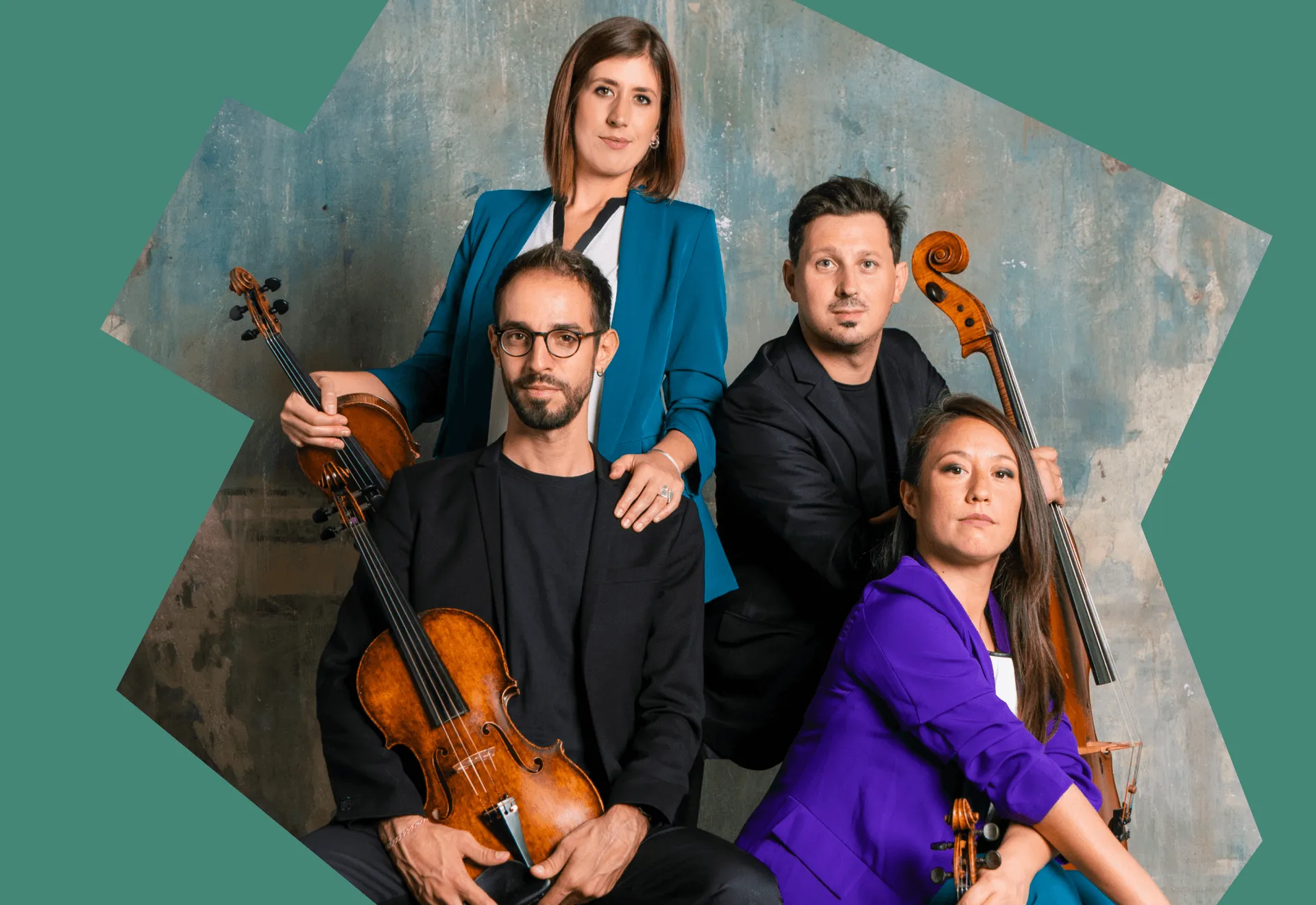
Quartetto Indaco
Quartetto Indaco
Synopsis
Among the finest Italian ensembles of today, the Quartetto Indaco rose to international prominence with its First Prize and two special awards at the Osaka Competition, becoming the first Italian ensemble to win gold at one of the major international string quartet competitions. This victory was followed by tours in Japan and Korea, as well as debuts at Wigmore Hall, Sala Verdi in Milan, the Amsterdam String Quartet Biennale, and the Parco della Musica in Rome. Celebrated for the sincerity, freshness, and deep sense of dialogue among its musicians, the Quartetto Indaco has explored a wide range of genres and styles, from Baroque to contemporary music, also thanks to the distinctive presence of a “composer in residence,” Cosimo Carovani, the group’s cellist as well as a prolific composer and arranger. The Quartetto Indaco was formed in the Italian cradle of the string quartet tradition at the Scuola di Musica di Fiesole, inspired by the vision of Piero Farulli. Alongside their academic path with their mentor Oliver Wille (Kuss Quartet), the ensemble has refined its craft with leading figures of the quartet world, including Günter Pichler (Primarius of the Alban Berg Quartet), Reiner Schmidt (Hagen Quartet), and the eminent German quartet pedagogue Eberhard Feltz. In its debut concert at the Festival di Spoleto, the Quartetto Indaco presents a program centered on folk music, featuring masterpieces by two composers profoundly influenced by the traditional songs of their homelands, Haydn and Ravel, alongside two world premieres by Carovani inspired by Tuscan and Spoleto folk songs.
Credits
Programma
Quartetto Indaco
Eleonora Matsuno, violin
Ida Di Vita, violin
Jamiang Santi, viola
Cosimo Carovani, cello
programme
Franz Joseph Haydn
String Quartet in D major, Op. 76 No. 5
Cosimo Carovani
String Quartet No. 5, “Seven Reflections on the Tuscan Folk Song ‘Maremma amara’” – World Premiere
Four Spoleto Songs for string quartet – World Premiere
Maurice Ravel
String Quartet in F major
Dates & Tickets

Playlist
Gallery
Immagini
Immagini
Video
Biographies
Related events
Noon Concerts
Noon Concerts
Noon Concerts
Noon Concerts
Noon Concerts
Noon Concerts
Noon Concerts
.webp)